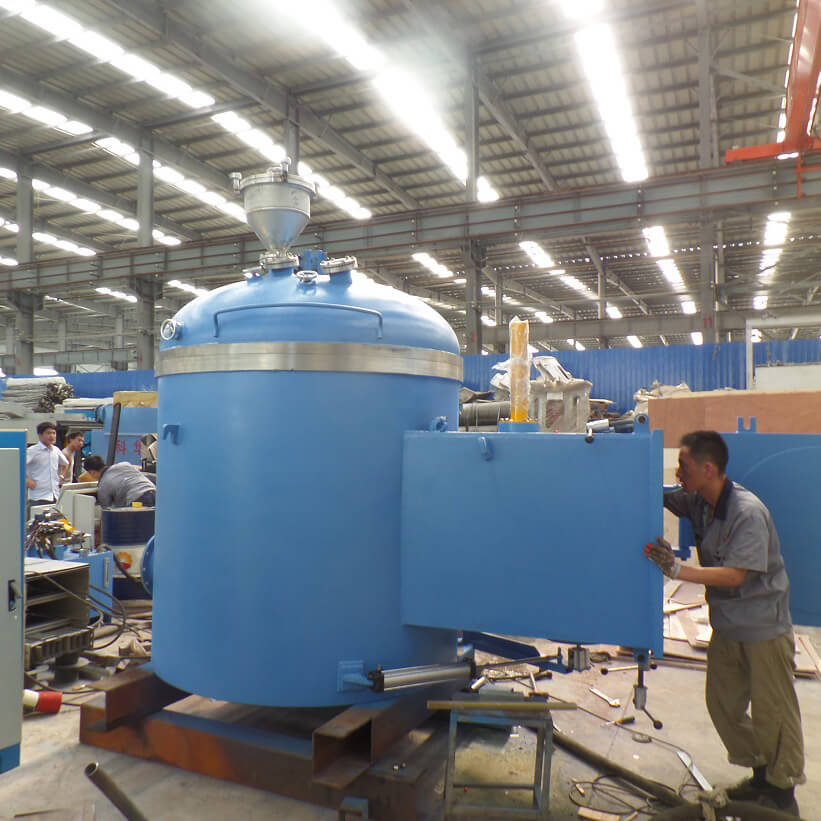
Vacuum Furnaces and Induction Melting Furnaces: Best Practices in Metal Processing
2025-12-22
In the field of metal processing, the choice of furnace technology can have a profound impact on the quality, efficiency, and cost-effectiveness of the production process. Vacuum furnaces and induction melting furnaces are the two most widely used furnace types in this industry, each with its own advantages and suitable for specific scenarios. Mastering the differences between these two technologies and implementing optimal operating schemes is crucial for achieving optimal results in metal processing. As a leader in advanced furnace technology, Kewah provides customized cutting-edge solutions tailored to the unique needs of different industries. This article will delve into the core differences between vacuum furnaces and induction melting furnaces, and elaborate on the best practical solutions to fully leverage their advantages in metal processing.
Analysis of Vacuum Furnace Technology: A vacuum furnace is a high-end heat treatment equipment that operates in a vacuum or controlled atmosphere environment. This technology is primarily applied to heat treatment processes such as annealing, brazing, sintering, and quenching, which require a pollution-free environment. The vacuum environment can minimize oxidation reactions and prevent the intrusion of impurities, thereby ensuring the highest quality of the processed metal.
Core application scenarios of vacuum furnaces:
Heat treatment process: Vacuum furnaces are suitable for various heat treatment processes such as annealing, quenching, tempering, and carburizing. These processes can enhance the mechanical properties of metals, including hardness, strength, and ductility, enabling them to meet the application requirements of demanding industries such as aerospace, automotive manufacturing, and medical devices.
Vacuum brazing: Material joining is achieved using filler metal in a vacuum environment. This process can form high-strength, corrosion-resistant joints without the need for flux, thus avoiding the introduction of impurities due to the use of flux. Vacuum furnaces are widely used in the production of complex components such as heat exchangers, fuel cells, and electronic assemblies.
Vacuum sintering: Achieving dense formation of metals, ceramics, and other materials through a high-temperature environment. This process plays an irreplaceable role in the manufacture of high-performance components such as turbine blades, cutting tools, and implants.
Optimal operation scheme for vacuum furnace:
Maintaining a clean environment: The core advantage of a vacuum furnace lies in its pollution-free processing environment. To maintain this advantage, it is necessary to ensure that the furnace chamber is clean and free of residues from previous processes.
Optimizing temperature control system: Precise temperature control is crucial for ensuring the stability of vacuum processing effects. It is recommended to adopt advanced temperature control and monitoring systems provided by companies such as Kewah to achieve precise and uniform temperature management throughout the entire process.
Implement regular maintenance: Regularly inspect and maintain the vacuum system, seals, and heating elements to ensure optimal equipment performance. Preventive maintenance can effectively avoid unexpected downtime and significantly extend equipment service life.
Analysis of Induction Melting Furnace Technology Induction melting furnaces are electric furnace equipment that utilize electromagnetic induction principles to heat and melt metals. This technology is widely used in foundries, steel enterprises, and recycling factories for metal melting, alloy preparation, and refining processes. Induction furnaces have prominent advantages such as high thermal efficiency, fast heating speed, and precise temperature control.
Core application scenarios of induction melting furnaces:
Metal melting: Induction furnaces are commonly used for melting ferrous and non-ferrous metals such as steel, aluminum, and copper. The precise temperature control provided by induction heating ensures uniform melting of metals, thereby obtaining high-quality castings.
Alloy preparation: Induction furnaces can achieve alloy preparation by melting different metals together, which is crucial for fields requiring specific performance materials such as aerospace, automotive manufacturing, and the electronics industry.
Recycling and Regeneration: Induction melting furnaces play a pivotal role in the field of metal recycling, efficiently melting scrap metal for circular utilization. This process combines environmental benefits with economic efficiency, effectively reducing the demand for primary raw materials.
Optimal operation scheme for induction melting furnace:
Standardized material preparation for loading: Before feeding, it is essential to ensure that the metal material is clean and free from contamination. Impurities can lead to a decrease in the purity of the molten metal, thereby affecting the quality of the final product.
Monitor power input: Induction melting relies on precise power control to achieve uniform heating. An advanced power monitoring system should be employed to dynamically adjust power levels, ensuring melting stability while avoiding overheating.
Maintaining the cooling system: The cooling system is crucial for maintaining the efficiency and service life of the induction furnace. Regular inspection and maintenance of the cooling device are necessary to prevent component damage caused by overheating of the equipment.
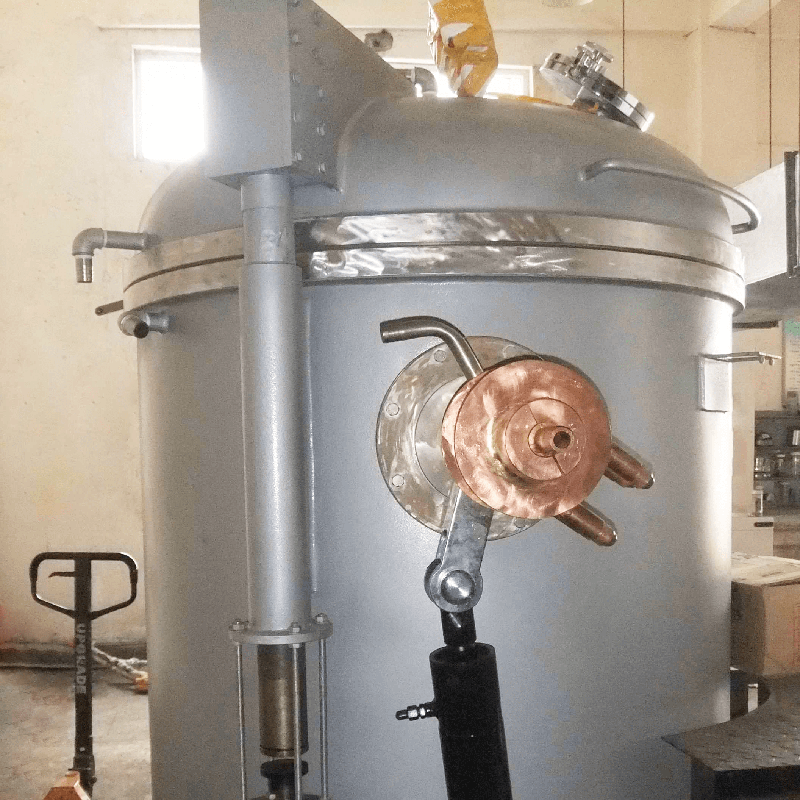
Comparison of core differences between vacuum furnaces and induction melting furnaces: Although both furnace types are crucial in metal processing, they have different functional orientations and advantageous characteristics:
Process focus:
Vacuum furnace: primarily suitable for heat treatment, brazing, and sintering processes that require a pollution-free environment and precise temperature control
Induction melting furnace: specializing in metal melting, alloy formulation, and recycling, featuring rapid heating and high efficiency
Operating environment:
Vacuum furnace: Operates under vacuum or controlled atmosphere, effectively preventing oxidation and contamination
Induction melting furnace: Operates in an open or inert atmosphere, focusing on rapid melting and efficient energy utilization
Material adaptability:
Vacuum furnace: suitable for high-value sensitive materials such as titanium alloys, high-temperature alloys, and special steels, requiring precise control of the heating environment
Induction melting furnace: Wide range of adaptability, covering various materials such as ferrous and non-ferrous metals
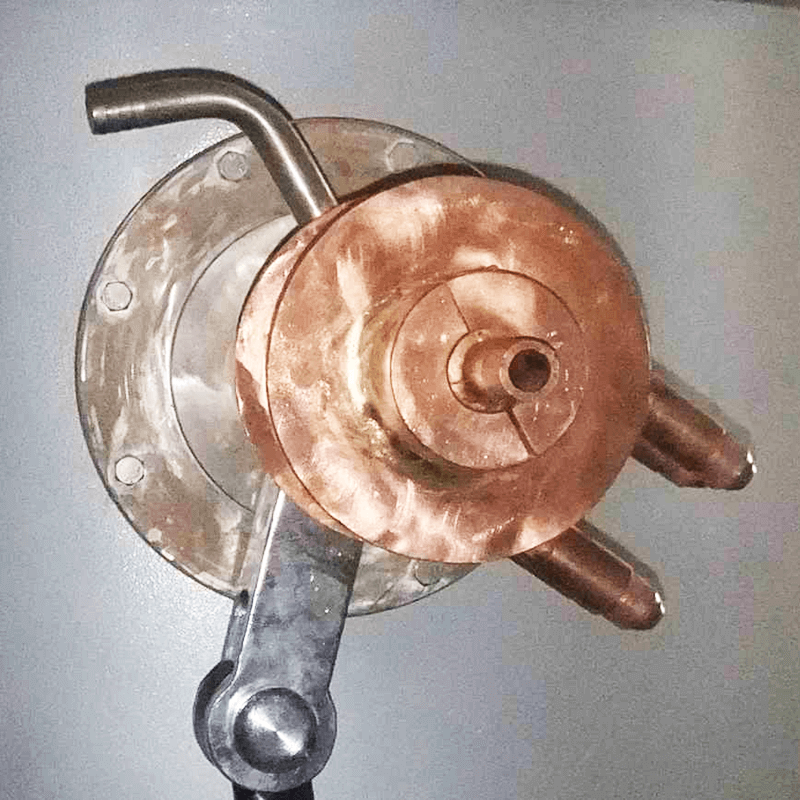
Industry Trend: The metal processing industry is continuously evolving with cutting-edge furnace technology developments. Significant advancements in furnace technology play a pivotal role in enhancing efficiency, product quality, and sustainability. Kewah has always been at the forefront of technological development, providing cutting-edge furnace solutions that meet the demands of industry transformation.
Sustainable and High-Efficiency Transformation: The metal processing industry is increasingly emphasizing energy efficiency and sustainable development. Both vacuum furnaces and induction furnaces are designed with these factors fully considered. The Kewah series furnaces achieve energy consumption minimization and emission reduction through engineering optimization, facilitating sustainable manufacturing practices.
Smart Manufacturing Integration: The integration of digital technologies such as the Internet of Things, big data analysis, and automation is transforming furnace operation models. Kewah's advanced furnace design can be seamlessly integrated with smart manufacturing systems to enable real-time monitoring, predictive maintenance, and production process optimization.
Conclusion: The selection of the correct furnace technology in the Kehua Metal Processing Best Practice Guide is the cornerstone for achieving optimal results in metal processing. Vacuum furnaces and induction melting furnaces each possess unique advantages, and understanding their differences can aid in selecting the most suitable equipment based on specific needs.
Vacuum furnaces are particularly suitable for processes that require a pollution-free environment and precise control, such as heat treatment, brazing, and sintering; whereas induction melting furnaces excel in the fields of metal melting, alloy preparation, and recycling, combining rapid heating with efficient energy utilization.
Kewah has always adhered to the spirit of innovation, upheld its commitment to quality, and implemented sustainable concepts to ensure that its vacuum furnaces and induction melting furnaces provide excellent performance and reliable guarantees. By following best practices and utilizing Kewah's advanced technology, enterprises can optimize metal processing workflows, enhance product quality, and achieve overall efficiency upgrades.